


Orizont

De la Wikipedia, enciclopedia liberă
Salt la: Navigare, căutare
Dezambiguizare
Pentru alte sensuri, vezi Orizont (dezambiguizare).
Orizont acvatic, fotografiat în nordul statului Wisconsin Wisconsin, Statele Unite ale Americii Statele Unite ale Americii, lacul Superior.

Prin orizont (ori linia cerului) se înțelege linia aparentă, care separă uscatul de cer, linia care divide toate direcțiile vizibile în cele care intersectează suprafața planetei noastre și cele care nu o intersectează.

În numeroase locuri, adevăratul orizont este obturat de clădiri, arbori, forme de relief, așa cum sunt coline, dealuri sau munți, ș.a.m.d.. Ca atare, rezultatul intersecției dintre linia uscatului cu linia cerului devine un orizont vizibil.

Cuvântul orizont, precum și toate echivalentele sale din limbile moderne indo-europene, derivă din cuvintele din greaca veche "ὁρίζων κύκλος" (horizōn kyklos), "cerc de separare", [1] din verbul "ὁρίζω" (horizō), "a diviza, a separa", [2] și din cuvântul "ὅρος" (oros), "margine, reper". [3]

Cuprins

[modificare] Aparență și utilizare

Vedere a orizontului planetei Pământ așa cum a fost observat și fotografiat de la bordul Navetei spațiale Endeavour, anul 2002.

[modificare] Distanța până la orizont

[modificare] Exemple cu unități din Sistemul Internațional

Distanța aproximativă până la orizont (adevăratul orizont), pentru un observator aflat aproape de suprafața Pământului, este dată de formula aproximativă [4]
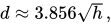
d \approx 3.856\sqrt{h} \,,

unde d este calculată în kilometri și h este înălțimea deasupra nivelului mării măsurată în metri.

Exemple

  • Pentru un observator aflat pe uscat, având distanța de la sol la nivelul ochilor de h = 1.70 m (o valoare medie a nivelului ochilor unei persoane), orizontul se va găsi la aproximativ 5 km.
  • Pentru un observator aflat pe o colină sau un turn de înălțime de 100 metri, distanța orizontului vizibil crește spectacular la circa 39 km.
  • Pentru un observator aflat pe Burj Khalifa, cel mai înalt zgărie nori din lume, orizontul se va afla la o distanță de 111 km.

[modificare] Exemple cu unități de măsură anglo-saxone

Pentru unități de măsură anglo-saxone, unde d este în mile terestre (1 milă = 1609 metri sau 1 milă = 5.280 picioare) și h este dat în picioare (1 picior = 30,48 cm), formula semi-empirică de mai sus devine
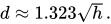
d \approx 1.323\sqrt{h} \,.

Exemple

  • Pentru un observator aflat la nivelul solului la nivelul ochilor de h = 5 picioare și 7 inch (sau 5.583 ft sau 1.70 m) (o valoare medie a nivelului ochilor unei persoane), orizontul se va găsi la aproximativ 3.1 mile (sau 5 km).
  • Pentru un observator aflat pe o colină sau turn de înălțime de circa 100 feet, orizontul se află la o distanță de 13.2 mile.
  • Pentru un observator aflat pe vârful montan Aconcagua, având 22,841 picioare, orizontul marin către vest va fi de circa 200 mile.

Aceste formule includ și efectul refracției atmosferice.

[modificare] Model geometric

Geometrical basis for calculating the distance to the horizon, secant tangent theorem
Geometrical distance to the horizon, Pythagorean theorem
Three types of horizon

If the Earth is assumed to be a perfect sphere with no atmosphere, then the theoretical formula for the distance of the horizon can easily be calculated using Euclidean geometry.

The secant tangent theorem states that

\mathrm{OC}^2 = \mathrm{OA} \times \mathrm{OB} \,.

Make the following substitutions:

  • d = OC = distance to the horizon
  • D = AB = diameter of the Earth
  • h = OB = height of the observer above sea level
  • D+h = OA = diameter of the Earth plus height of the observer above sea level

The formula now becomes

d^2 = h(D+h)\,\!

or

d = \sqrt{h(D+h)} =\sqrt{h(2R+h)}\,,

where R is the radius of the Earth.

Alternatively, this equation can be derived using the Pythagorean theorem. Since the line of sight is a tangent to the Earth, it is perpendicular to the radius at the horizon. This sets up a right triangle, with the sum of the radius and the height as the hypotenuse. With

  • d = distance to the horizon
  • h = height of the observer above sea level
  • R = radius of the Earth

referring to the second figure at the right leads to the following:

(R+h)^2 = R^2 + d^2 \,\!
R^2 + 2Rh + h^2 = R^2 + d^2 \,\!
d = \sqrt{h(2R + h)} \,.

Another relationship involves the distance s along the curved surface of the Earth to the horizon; with γ in radians,

s = R \gamma \,;

then

\cos \gamma = \cos\frac{s}{R}=\frac{R}{R+h}\,.

Solving for s gives

s=R\cos^{-1}\frac{R}{R+h} \,.

The distance s can also be expressed in terms of the line-of-sight distance d; from the second figure at the right,

\tan \gamma = \frac {d} {R} \,;

substituting for γ and rearranging gives

s=R\tan^{-1}\frac{d}{R} \,.

The distances d and s are nearly the same when the height of the object is negligible compared to the radius (that is, h ≪ R).

[modificare] Formule geometrice aproximative

How far away is the horizon.png

If the observer is close to the surface of the earth, then it is valid to disregard h in the term (2R + h), and the formula becomes

d = \sqrt{2Rh} \,.

Using metric units and taking the radius of the Earth as 6371 km, the distance to the horizon is

d \approx \sqrt{12.74h} \approx 3.57\sqrt{h} \,,

where d is in kilometres, and h is the height of the eye of the observer above ground or sea level in metres.

Using imperial units, the distance to the horizon is

d \approx \sqrt{1.50h} \approx 1.22 \sqrt{h} \,,

where d is in miles and h is in feet.

These formulas may be used when h is much smaller than the radius of the Earth (6371 km), including all views from any mountaintops, aeroplanes, or high-altitude balloons. With the constants as given, both the metric and imperial formulas are precise to within 1% (see the next section for how to obtain greater precision).

[modificare] Formula exactă pentru un Pământ sferic

If h is significant with respect to R, as with most satellites, then the approximation made previously is no longer valid, and the exact formula is required:

d = \sqrt{2Rh + h^2} \,,

where R is the radius of the Earth (R and h must be in the same units). For example, if a satellite is at a height of 2000 km, the distance to the horizon is 5.430 kilometres (Eroare de expresie: operand lipsă pentru * ); neglecting the second term in parentheses would give a distance of 5.048 kilometres (Eroare de expresie: operand lipsă pentru * ), a 7% error.

[modificare] Obiecte aflate deasupra orizontului

Geometrical horizon distance

To compute the height of an object visible above the horizon, compute the distance to the horizon for a hypothetical observer on top of that object, and add it to the real observer's distance to the horizon. For example, for an observer with a height of 1.70 m standing on the ground, the horizon is 4.65 km away. For a tower with a height of 100 m, the horizon distance is 35.7 km. Thus an observer on a beach can see the tower as long as it is not more than 40.35 km away. Conversely, if an observer on a boat (h = 1.7 m) can just see the tops of trees on a nearby shore (h = 10 m), the trees are probably about 16 km away.

Referring to the figure at the right, the lighthouse will be visible from the boat if

D_\mathrm{BL} < 3.57\,(\sqrt{h_\mathrm{B}} + \sqrt{h_\mathrm{L}}) \,,

where DBL is in kilometres and hB and hL are in metres. If atmospheric refraction is considered, the visibility condition becomes

D_\mathrm{BL} < 3.86\,(\sqrt{h_\mathrm{B}} + \sqrt{h_\mathrm{L}}) \,.

[modificare] Efectul refracției atmosferice

Because of atmospheric refraction of light rays, the actual distance to the horizon is slightly greater than the distance calculated with geometrical formulas. With standard atmospheric conditions, the difference is about 8%; however, refraction is strongly affected by temperature gradients, which can vary considerably from day to day, especially over water, so calculated values for refraction are only approximate.[4]

Rigorous method—Sweer
The distance d to the horizon is given by[5]

d={{R}_{\text{E}}}\left( \psi +\delta  \right) \,,

where RE is the radius of the Earth, ψ is the dip of the horizon and δ is the refraction of the horizon. The dip is determined fairly simply from

\cos \psi =\frac{{{R}_{\text{E}}}{{\mu }_{0}}}{\left( {{R}_{\text{E}}}+h \right)\mu } \,,

where h is the observer's height above the Earth, μ is the index of refraction of air at the observer's height, and μ0 is the index of refraction of air at Earth's surface.

The refraction must be found by integration of

\delta =-\int_{0}^{h}{\tan \phi \frac{\text{d}\mu }{\mu }} \,,

where \phi\,\! is the angle between the ray and a line through the center of the Earth. The angles ψ and \phi\,\! are related by

\phi =90{}^\circ -\psi \,.

Simple method—Young
A much simpler approach uses the geometrical model but uses a radius R′ = 7/6 RE. The distance to the horizon is then[4]

d=\sqrt{2 R^\prime h} \,.

Taking the radius of the Earth as 6371 km, with d in km and h in m,

d \approx 3.86 \sqrt{h} \,;

with d in mi and h in ft,

d \approx 1.32 \sqrt{h} \,.

Results from Young's method are quite close to those from Sweer's method, and are sufficiently accurate for many purposes.

[modificare] Curbura orizontului

From a point above the surface the horizon appears slightly bent (it is a circle, after all). There is a basic geometrical relationship between this visual curvature \kappa, the altitude and the Earth's radius. It is

\kappa=\sqrt{\left(\frac{R+h}{R}\right)^2-1}\ .

The curvature is the reciprocal of the curvature angular radius in radians. A curvature of 1 appears as a circle of an angular radius of 45° corresponding to an altitude of approximately 2640 km above the Earth's surface. At an altitude of 10 km (33,000 ft, the typical cruising altitude of an airliner) the mathematical curvature of the horizon is about 0.056, the same curvature of the rim of circle with a radius of 10 m that is viewed from 56 cm. However, the apparent curvature is less than that due to refraction of light in the atmosphere and because the horizon is often masked by high cloud layers that reduce the altitude above the visual surface.

A man dives against the horizon into the Great South Bay of Long Island

[modificare] Vezi și

[modificare] Note

  1. ^ "ὁρίζων", Henry George Liddell and Robert Scott, A Greek-English Lexicon. On Perseus Digital Library. Accessed 19 April 2011.
  2. ^ "ὁρίζω", Liddell and Scott, A Greek-English Lexicon.
  3. ^ "ὅρος", Liddell and Scott, A Greek-English Lexicon.
  4. ^ a b c Andrew T. Young, "Distance to the Horizon". Accessed 16 April 2011.
  5. ^ John Sweer, "The Path of a Ray of Light Tangent to the Surface of the Earth", Journal of the Optical Society of America, 28 (September 1938):327–29. Available as paid download.

[modificare] Legături externe

Unelte personale
Spații de nume

Variante
Vizualizări
Acțiuni
Navigare
Participare
Tipărire/exportare
Trusa de unelte
În alte limbi